

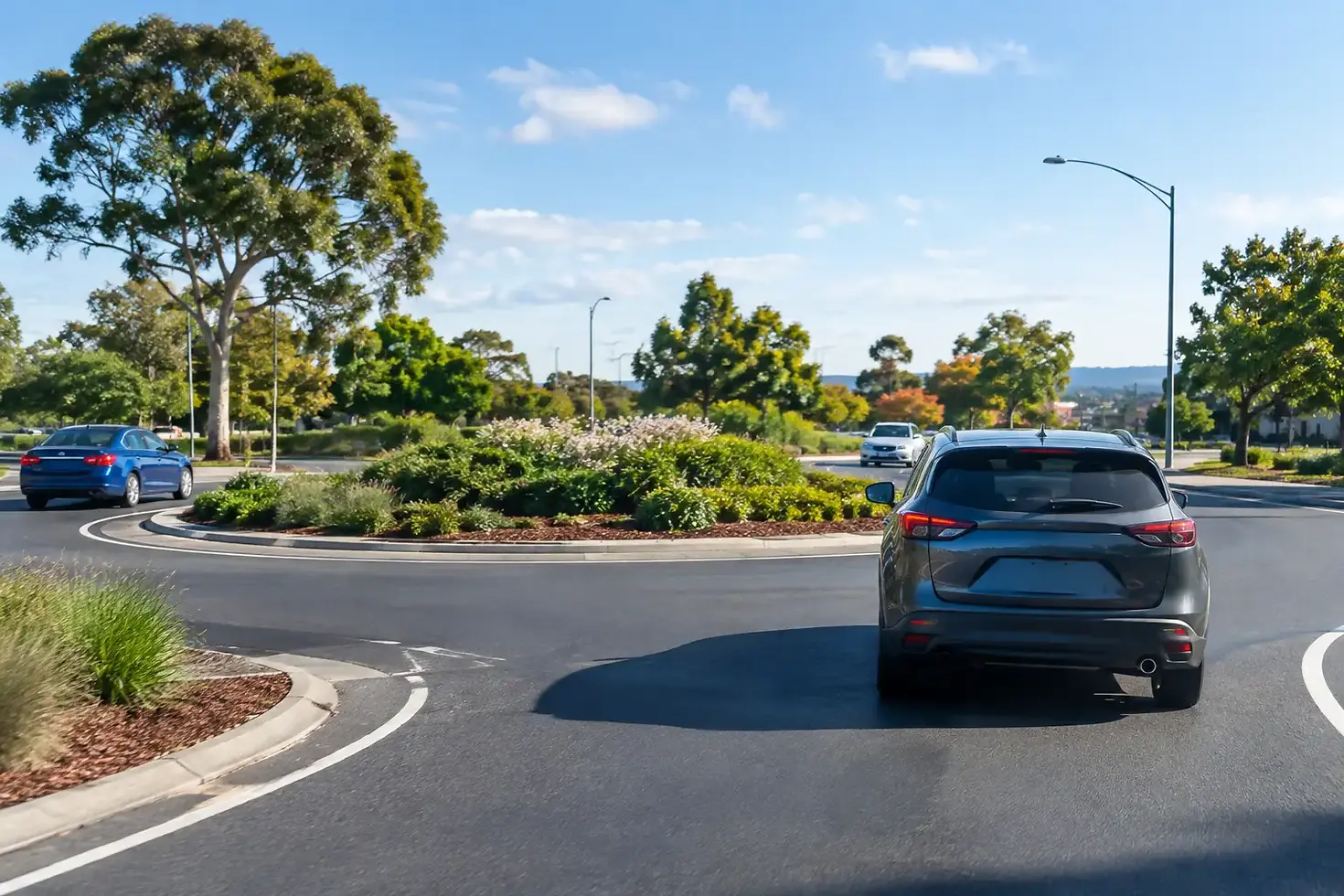
How to Navigate Roundabouts Safely in Victoria

A roundabout can feel straightforward when the road is quiet, then suddenly confusing when there are cars approaching from several directions, a truck beside you or traffic waiting behind. Learning how to navigate roundabouts properly is not about rushing through. It is about reading the signs early, choosing the correct lane, giving way when required and making your intentions clear to everyone around you.
For learners in Leongatha, Korumburra, Wonthaggi and Inverloch, roundabouts are part of everyday driving. They also appear regularly on VicRoads driving-test routes, so building calm, repeatable habits now will help you drive safely for life.
The first rule: give way to vehicles already in the roundabout
In Victoria, you must give way to all vehicles already in the roundabout. That includes vehicles approaching from your right that have entered before you, but the key point is not simply to look right and go. Look carefully at the whole roundabout and check whether any vehicle is already circulating across your path.
Slow down as you approach. This gives you time to assess the traffic without braking sharply at the give-way line. If another vehicle is in the roundabout and you would interfere with its path, wait. A short pause is always safer than trying to squeeze into a gap that is not really there.
Do not assume another driver will exit just because they are positioned near an exit or because their indicator is on. Indicators are useful information, but they are not a guarantee. Wait until you can see that the vehicle is genuinely leaving the roundabout or that there is enough space for you to enter safely.
Plan before you reach the line
The best way to make roundabouts less stressful is to make most decisions before you arrive at them. Look ahead for directional signs, road markings and lane arrows. They tell you which lane to use and often show where each lane is expected to go.
As you approach, check your mirrors, reduce speed and identify your intended exit. If you are turning left, use the left lane where marked or appropriate. If you are turning right, use the right lane where marked or appropriate. For straight ahead, follow the lane arrows and signs. At smaller single-lane roundabouts, the choice is simpler, but you still need to approach at a speed that lets you give way safely.
A common learner mistake is changing lanes at the last moment because they have noticed the wrong arrow too late. If you have missed your lane, do not force your way across. Continue safely, take the exit available to you if necessary and find a safe place to turn around. Missing a turn is inconvenient. A sudden lane change can cause a crash.
Match your speed to the roundabout
There is no single speed that suits every roundabout. A compact roundabout in a residential street may require you to roll in very slowly, while a larger roundabout on a main road may have several lanes and faster-moving traffic. In wet weather, at night or when visibility is poor, allow even more space and time.
Aim to approach smoothly, with your speed reduced before the give-way line. Braking heavily while turning can unsettle the car and makes it harder to observe traffic. Smooth braking, a steady steering input and gentle acceleration once it is safe will make the manoeuvre feel far more controlled.
Signalling when you enter and leave
Correct signalling helps other drivers, cyclists and pedestrians understand what you intend to do. It also gives your driving examiner clear evidence that you are planning ahead.
If you are turning left at the first exit, signal left as you approach the roundabout and keep the indicator on until you leave. If you are turning right, signal right as you approach and while travelling through the roundabout. Then change to a left signal before you exit, where practical.
When travelling straight ahead, you generally do not need to signal as you enter. However, you should signal left as you pass the exit before the one you are taking, where practical. For example, if you are going straight through a four-way roundabout, indicate left after passing the first exit and before leaving at the second.
If you are making a U-turn at a roundabout, signal right on approach and through the roundabout, then signal left before exiting. Keep your steering controlled and stay in the correct lane throughout the turn.
There are occasions when a very small roundabout does not give you much time to signal left before exiting. Safety comes first. Focus on controlling the vehicle, watching for traffic and pedestrians, and make the left signal when it can be done safely.
How to navigate roundabouts with more than one lane
Multi-lane roundabouts need extra attention because vehicles may be beside you as well as in front of you. The signs and painted arrows before the roundabout are your guide. Follow them, stay in your lane and avoid drifting across lane lines.
Before entering, check your mirrors and do a head check if you are moving into another lane. Once you are in the roundabout, keep looking ahead while remaining aware of vehicles beside you. Do not assume a vehicle in the outside lane will exit before you, and do not cut across another lane to reach your exit.
Large roundabouts can also have traffic lights, slip lanes or marked bicycle crossings. Treat each feature as its own decision point. A green light does not remove the need to watch for other road users, and an empty-looking lane can still contain a cyclist in your blind spot.
If you feel uncertain, choose the safest legal option and continue around rather than making a rushed move. Taking an extra circuit is not ideal if it creates confusion for other drivers, but it can be safer than swerving across lanes. In a driving lesson, practising these situations gradually can make a big difference to your confidence.
Watch for pedestrians, cyclists and larger vehicles
Roundabouts are shared spaces. People walking may be waiting at crossings on the roads leading into or out of the roundabout. Check carefully as you exit, particularly near schools, shops and busy town centres. A pedestrian may be focused on traffic coming from another direction, so never rely on them seeing you first.
Cyclists can be harder to spot, particularly at dusk, in rain or when you are focused on finding your exit. Give them room, check mirrors before changing position and be patient. Do not overtake a cyclist through a roundabout unless there is clearly enough space and it is safe to do so.
Trucks, buses, caravans and farm vehicles may need extra room to turn. Some larger vehicles need to use more than one lane or track close to the centre island. Hanging back gives the driver space to complete the turn and gives you a better view of the road ahead. This is particularly relevant on South Gippsland roads where you may meet heavy vehicles, utes towing trailers or agricultural machinery.
Common roundabout mistakes to avoid
Many errors come from trying to be overly polite or overly decisive. Stopping unnecessarily when the roundabout is clear can surprise the driver behind you. Entering without properly checking can put you in the path of a vehicle already circulating. The goal is not to hesitate, but to make a clear decision based on what you can see.
Another common mistake is entering too fast. Fast approaches reduce your time to observe, leave little room for braking and can make a small roundabout feel much tighter than it is. Keep your eyes moving between the signs, the give-way line, the traffic and your intended exit.
Remember these four practical habits:
Slow down early enough to observe without panic braking.
Give way to vehicles already in the roundabout.
Follow lane arrows and stay in your lane.
Signal clearly when turning and when exiting where practical.
Build confidence one roundabout at a time
Nervous drivers often worry about holding up traffic. In reality, taking a moment to assess a roundabout properly is responsible driving. Other road users can wait a few seconds. What matters is that you enter only when you have a safe gap and can continue smoothly.
Start by practising at quieter local roundabouts outside peak periods. Repeat the same route until the routine feels familiar: mirrors, signs, speed, give way, steer, exit. Then progress to busier roundabouts, multi-lane intersections and city traffic when you are ready. The skills are the same, but the timing and observation become more demanding.
A patient instructor can help by talking through what you are seeing before you need to act. South Gippsland Driving Lessons works with learners and nervous licensed drivers to practise real local conditions, as well as prepare for the more complex traffic you may meet in Melbourne.
Roundabouts become easier when you stop treating them as one big test and start seeing them as a series of small, manageable decisions. Stay calm, look early and give yourself permission to wait for the safe gap.


Comments